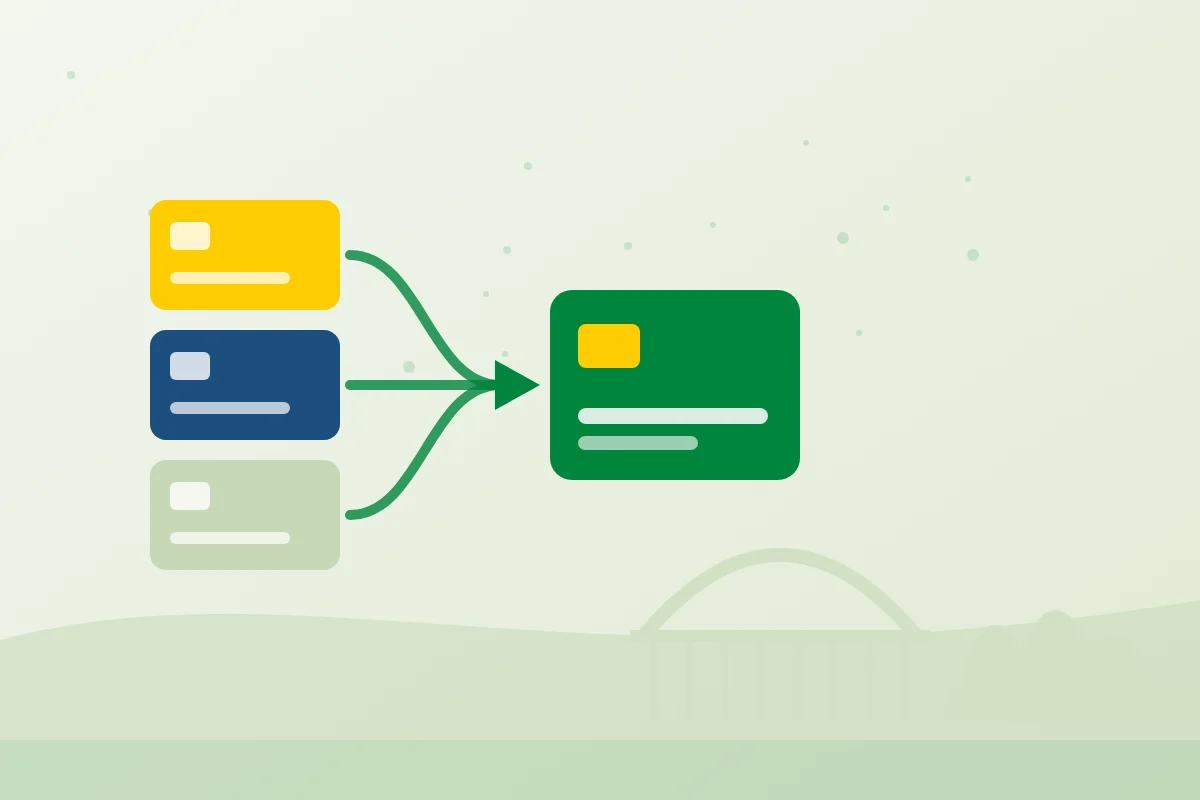
With debt consolidation you pay off several loans and credit cards with one new loan. In the best case you pay less interest and have one repayment to manage. Whether it pays off depends on the rate, the term and the fees. A worked example shows what matters.
When consolidation makes sense
- You have several loans, credit cards or buy now pay later balances.
- You carry a credit card balance at a high rate from month to month.
- Your credit score has improved since you took out your loans.
It makes little sense if the old loans are almost paid off or the new rate is hardly lower.
Worked example: three debts become one
| Debt | Balance | Term left | Rate | Monthly repayment |
|---|---|---|---|---|
| Personal loan | $6,000 | 36 months | 16.9% | $213.62 |
| Credit card 1 | $4,000 | 24 months | 20.99% | $205.52 |
| Credit card 2 | $3,000 | 24 months | 21.99% | $155.62 |
| Total | $13,000 | $574.76 |
If you carry on, you will pay $3,357.66 in interest. A new loan of $13,000 over 36 months at 10.9% costs $424.99 a month and $2,299.57 in interest.
- Interest saved: $1,058.09
- Monthly repayment: about $150 lower
- Subtract the establishment fee and any early repayment fee.
Watch the term:
| Term of new loan | Monthly repayment | Total interest |
|---|---|---|
| 24 months | $605.30 | $1,527.16 |
| 36 months | $424.99 | $2,299.57 |
| 48 months | $335.36 | $3,097.32 |
Over 48 months the repayment is lowest, but most of the saving is gone. The rates are examples; check your own with the loan calculator.
Early repayment fees
Credit cards have no early repayment fee. Variable-rate personal loans often let you repay early for free, while fixed-rate loans may charge a fee. Ask each lender for the payout figure, including any fees, before you consolidate.
Balance transfer cards
A 0% balance transfer card can be cheaper than a loan, but only if you clear the balance before the promotional period ends. After that, a much higher rate applies to what is left, and new purchases may attract interest straight away. A personal loan with a fixed end date is often the safer choice.
Step by step
- List all debts: balance, rate, repayment and term left.
- Ask for payout figures including fees.
- Get quotes and compare the comparison rate and total cost.
- Pay off the old debts and get written confirmation.
- Close or reduce card limits: unused limits still count in credit assessments.
Common mistakes
- Only looking at the lower repayment.
- Borrowing extra while consolidating.
- Using the cleared credit cards again.
- Paying a debt management firm for something you could arrange yourself.
When consolidation is not enough
If you can only make your repayments by borrowing more, another loan won't help. The National Debt Helpline (1800 007 007) offers free financial counselling, and your lenders must consider a hardship request.
Frequently asked questions
Can I consolidate with bad credit?
It is harder. Read our guide to bad credit loans.
Does the repayment always go down?
Not necessarily. What matters is whether the total cost goes down.
Should I close my credit cards?
Closing or reducing limits removes the temptation and can improve your borrowing capacity.
Can I add debt to my home loan instead?
It is often cheaper per year, but you repay over decades, so the total interest can be higher.